
The weekly Bitcoin brief, issue #3
Binance lost $6.3 billion from its online wallets. The Fed held rates, Bitcoin Core 32.1 shipped, and the white paper turned 18.

Week ending Nov 1, 2026.
Thursday brought the largest exchange theft on record. Binance says about $6.3 billion left its online wallets, and it says it will cover the losses. This issue walks through what that does and does not mean for bitcoin you hold, plus the week in numbers and an 18th birthday for the white paper.
Follow @coldhardsatshq on X. Past issues: Issue #1 · Issue #2.
In this issue:
| ● Price vs. trend | ● Feature |
| ● What if? | ● FUD Corner |
| ● Network | ● Security |
| ● News | ● Term of the week |
| ● Adoption | ● Videos |
| ● Ask us |
Price vs. trend
| 📈 | $77,401, about 55% below trend. Far below trend by that model (5th percentile historically). |
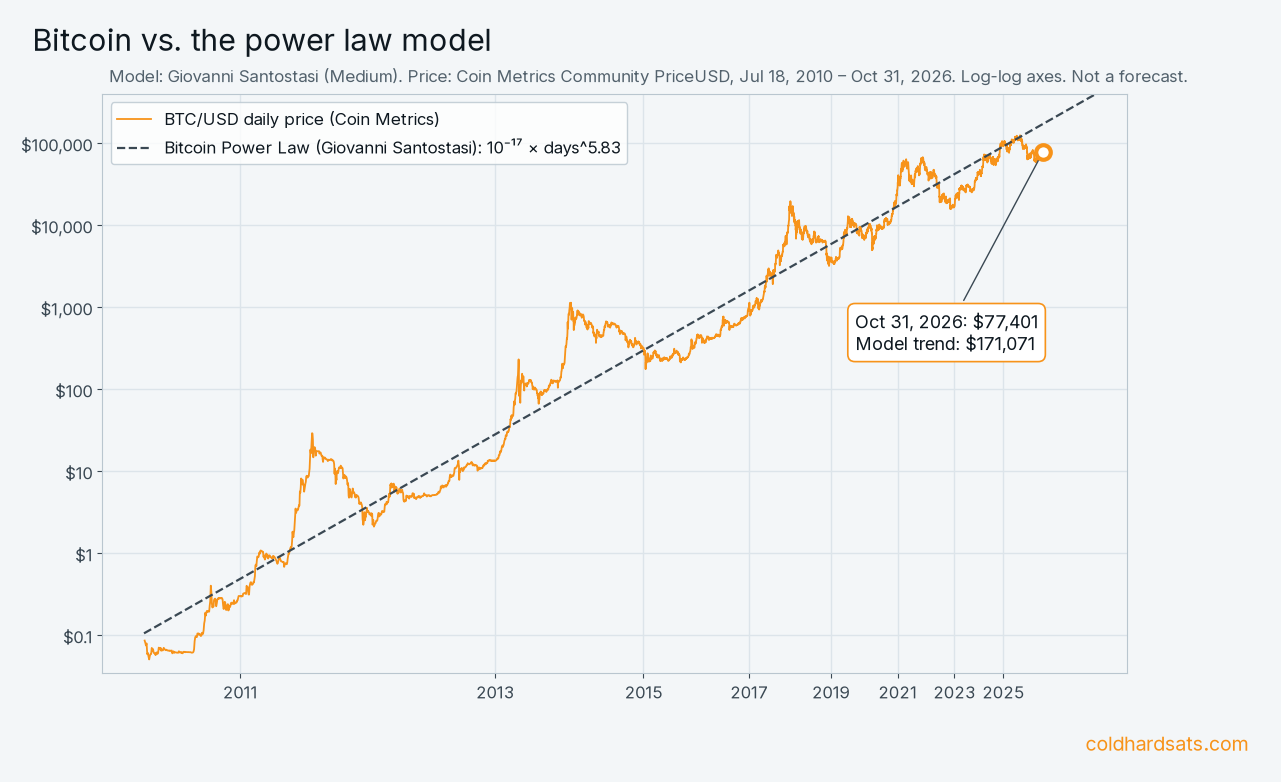
Bitcoin closed Oct 31 at $77,401 by Coin Metrics' count, down 4.1% from $80,699 on Oct 24, the close used in issue #2[2]. Santostasi's model puts the Oct 31 trend near $171,000, so price sits at 0.45x trend. Price has been this far or further below trend on about 5% of days since July 2010[2][1].* That describes the past. It is not a forecast and not a signal to buy.
| 📊 | What if? $1,000 to start, $100 a week |
| This issue (hypothetical) | |
| Total put in | $1,200 |
| BTC | 0.0148 |
| Average price | $80,885 |
| Would be worth | $1,148 |
| Change | −4.3% |
Network
- Block height: 974,131[3]
- Next halving: block 1,050,000, 75,869 blocks away. Around April 8, 2028 (~524 days).†
- Block subsidy: 3.125 BTC[4]
- Hashrate: about 1,071 EH/s, mempool.space's current estimate[5]
- Difficulty: about 148.4 trillion after a +5.5% adjustment on Oct 29. The next one comes in 1,613 blocks (around Nov 12) and is estimated at −0.8%[6]
- Supply issued: about 20.1 million BTC, roughly 95.7% of a total capped at just under 21 million.‡
- Fees are near the floor: 1–3 sat/vB on Sunday morning[7].
See the live mining difficulty estimate
This week in Bitcoin
- The Fed held rates at 3.75% to 4%. The Federal Reserve's rate-setting committee voted 10 to 2 on Oct 28 to keep its benchmark range where it has been since September. The two dissenters wanted another quarter-point increase, and the statement said inflation "remains elevated"[8]. Higher rates make cash and bonds pay more, which is one reason markets watch these meetings closely. See Fed meeting dates and history
- Bitcoin Core 32.1 shipped. Bitcoin Core is the most widely used software for running a node, a computer that checks every bitcoin rule for itself. Version 32.1 came out Oct 27. It adds a fee estimator that also looks at transactions waiting to be confirmed, speeds up block checking, and lets a wallet be exported as watch-only, meaning it can see balances but cannot spend. Versions 29.x and older no longer get updates[9].
- Spot bitcoin funds ended the week slightly negative. By Farside's count, U.S. spot bitcoin ETFs took in $440.8 million over Oct 26–29, then saw $643.2 million go out on Oct 30, the day after the Binance news. That left the week at about −$202.4 million[10]. Fund flows measure dollars moving through brokerage products, not coins leaving the network.
Adoption watch
- Strategy paused its weekly buys. Strategy (formerly MicroStrategy) is a public company that holds bitcoin as its main treasury asset. Its Oct 26 Form 8-K, a required SEC filing, said it neither bought nor sold bitcoin Oct 19–25 and still holds about 848,517 BTC, bought at an average of about $75,446 each[11].
- IBIT held about $62.3 billion. IBIT is BlackRock's spot bitcoin ETF, a fund that lets ordinary brokerage accounts hold bitcoin price exposure. It reported net assets of $62,297,756,860 as of Oct 30, down from about $65.9 billion on Oct 23 as the price fell[12].
- Cumulative ETF flows stay positive. Farside shows about +$57.0 billion in total net flows into U.S. spot bitcoin ETFs since they launched in January 2024, through Oct 30[10].
More on adoption → coldhardsats.com/adoption
Feature: the white paper turned 18
On Oct 31, 2008, someone using the name Satoshi Nakamoto announced a nine-page paper called "Bitcoin: A Peer-to-Peer Electronic Cash System"[13][14]. Saturday was its 18th birthday.
The paper's opening problem is a simple one. Paying online meant trusting a third party, usually a bank or payment company, to keep the books honestly[13]. Satoshi proposed a system "based on cryptographic proof instead of trust," where two people could pay each other directly and a public, time-stamped chain of blocks would stop anyone from spending the same coin twice[13]. About two months later, on Jan 3, 2009, the first block was mined[1].
This week makes the old argument feel current. Coins held on an exchange are an IOU from a company that holds the keys for you. When that company's online wallets get hit, you wait for its announcements. Coins held with your own keys sit on the network the paper described, which kept producing blocks right through the news[3].
Read the white paper, explained section by section
FUD Corner: "The biggest hack ever means bitcoin got hacked"
| 🔍 | The claim: If $6.3 billion can be stolen in one night, bitcoin itself must be broken. |
Read our take on "bitcoin is dead" headlines
Security Corner
Binance lost about $6.3 billion from its hot wallets. Binance says its hot wallets were compromised around 4:05 PM ET on Oct 29 (20:05 UTC), and it puts the total at about $6.3 billion in tokens[16]. It suspended withdrawals, revoked the affected access, and says about $3 billion has been frozen on-chain with help from partners[15][16]. Binance says it will cover all stolen funds from its user protection fund (SAFU) and its own company funds, and that it has found no evidence private keys leaked[16]. By Nov 1 it said about 95% of the loss was already covered, and it reopened bitcoin withdrawals that day[17][19]. Customers took out $4.65 billion and put in $1.01 billion on Nov 1, a net outflow of about $3.64 billion, Binance said[19]. The FBI said on Oct 31 that North Korean hackers it calls TraderTraitor were behind the theft[20].
What that means if you use an exchange. Coins on an exchange sit in wallets the exchange controls. You hold a claim on the company, and you depend on its security and its promise to make you whole. That is the trade-off for convenience, and it is why many people move long-term savings to a wallet where they hold the keys.
Watch for the scams that follow. After a big breach, fake "refund," "claim your compensation" and "verify your account" messages tend to show up. No real company needs your recovery words. If a message asks for them, it is a scam.
| 🔒 | One thing to do this week: Check where your bitcoin actually lives. If it is on an exchange, learn what moving it to your own wallet involves before you decide anything. |
Where is my bitcoin? Your wallet holds keys, not coins
Term of the week: hot wallet
A hot wallet is a wallet whose keys sit on a device connected to the internet, like a phone app or an exchange's payout system. It is handy for spending and quick transfers. Being online is also what makes it a target, which is what happened at Binance this week[15]. The opposite is cold storage: keys kept offline, often on a hardware wallet.
Look up cold storage in the glossary
This week's video picks
Picked from the latest uploads on the Cold Hard Sats videos page, Oct 26–Nov 1. Titles as shown there.¶
- News & Markets: Bitcoin Held Up Through A $6 Billion Hack by The Bitcoin Layer, Oct 30[18].
- Interviews & Podcasts: Lyn Alden on Fiscal Dominance, 7% Mortgages, and Bitcoin's 10-Year Outlook by Natalie Brunell (Coin Stories), Oct 30[18].
- Interviews & Podcasts: The Fed Can't Hike Its Way Out of This | James Lavish by What Bitcoin Did, Oct 29[18].
Ask us anything
| ❓ | My bitcoin is on Binance. Did I lose it? Binance says customers will not bear the loss and that it is covering stolen funds from its own reserves[16]. It says about 95% is already covered, and it reopened bitcoin withdrawals on Nov 1[19]. We can't check any one account for you. If you want your coins under your own keys, fees were 1–3 sat/vB this morning[7], which makes moving them cheap. Learn the steps first so you do it calmly. Where is my bitcoin? |
Got a question? Reply to this email. We read every reply.
More from Cold Hard Sats: @coldhardsatshq on X · Issue #1 · Issue #2 · news.coldhardsats.com
Ready for more?
That's issue #3. Keep your keys close and your recovery words offline. See you next week.
— Cold Hard Sats
Learn Bitcoin, one block at a time.
coldhardsats.com
Notes
* Model: price = 10⁻¹⁷ × (days since Jan 3, 2009)^5.83; Oct 31 is day 6,510[1]. Trend ≈ $171,071; ratio ≈ 0.452. The verdict ranks the Oct 31 distance from trend among all days since July 18, 2010 (Coin Metrics daily prices through Oct 31, 2026, 5,950 days, accessed Nov 1, 2026, 9:05 AM ET[2]). About 294 of 5,950 days (4.9%) closed at this distance or further below trend. The power law models past data. It is not a prediction; price can stay far from trend for years, and the relationship could break.
† 75,869 blocks × 597.1 s average block time in the current difficulty period[6] ÷ 86,400 s/day ≈ 524 days. Rough, since block times vary. Network data from mempool.space, Nov 1, 2026, ~9:05 AM ET.
‡ From the subsidy schedule[4]: 19,687,500 BTC for blocks 0–839,999, plus 3.125 BTC × 134,132 blocks (840,000–974,131) = 20,106,662.5 BTC, about 95.7% of 21 million. An upper bound, since it counts lost or unspendable coins.
†† Illustration method (hypothetical; excludes fees, spreads and taxes): issue #1 assumes $1,000 at the Coin Metrics Community daily PriceUSD close for Oct 17, 2026, $81,268.94 (0.01230482 BTC). Issue #2 assumes $100 at the Oct 24 close, $80,699.31 (0.00123917 BTC). Issue #3 (this week) assumes $100 at the Oct 31 close, $77,401.02[2] (0.00129197 BTC). BTC held = 0.01483596; average price = $1,200 ÷ 0.01483596 ≈ $80,885; value = 0.01483596 × $77,401.02 = $1,148.32 (shown $1,148); change = ($1,148.32 ÷ $1,200 − 1) × 100 = −4.3%. Accessed Nov 1, 2026, 9:05 AM ET.
¶ Titles, channels and dates as shown on coldhardsats.com/videos, checked Nov 1, 2026, ~9:10 AM ET; titles confirmed against YouTube.
Sources
- Giovanni Santostasi, "BTC Trolololo model revisited (still valid today) is really a Power Law in disguise," Medium, January 2024. https://giovannisantostasi.medium.com/btc-trolololo-model-revisited-still-valid-today-is-really-a-power-law-in-disguise-da11b58cf5de
- Coin Metrics, "Community API: BTC PriceUSD, daily," Jul 18, 2010 – Oct 31, 2026, accessed Nov 1, 2026, 9:05 AM ET. https://community-api.coinmetrics.io/v4/timeseries/asset-metrics?assets=btc&metrics=PriceUSD&frequency=1d
- mempool.space, "Block tip height API," accessed Nov 1, 2026, ~9:05 AM ET. https://mempool.space/api/blocks/tip/height
- Bitcoin Core, "validation.cpp (GetBlockSubsidy)," GitHub. https://github.com/bitcoin/bitcoin/blob/master/src/validation.cpp
- mempool.space, "Mining hashrate API (1 week)," accessed Nov 1, 2026, ~9:05 AM ET. https://mempool.space/api/v1/mining/hashrate/1w
- mempool.space, "Difficulty adjustment API," accessed Nov 1, 2026, ~9:05 AM ET. https://mempool.space/api/v1/difficulty-adjustment
- mempool.space, "Recommended fees API," accessed Nov 1, 2026, ~9:05 AM ET. https://mempool.space/api/v1/fees/recommended
- Federal Reserve, "Federal Reserve issues FOMC statement," Oct 28, 2026. https://www.federalreserve.gov/newsevents/pressreleases/monetary20261028a.htm
- Bitcoin Core, "Bitcoin Core 32.1 release notes," published Oct 27, 2026, accessed Nov 1, 2026. https://bitcoincore.org/en/releases/32.1/
- Farside Investors, "Bitcoin ETF Flow – All Data," accessed Nov 1, 2026 (daily totals Oct 26–30, 2026: +110.3, +176.0, +137.3, +17.2, −643.2 $M; cumulative total $57,048M). https://farside.co.uk/btc/
- Strategy Inc, Form 8-K, Oct 26, 2026 (SEC EDGAR). https://www.sec.gov/Archives/edgar/data/1050446/000119312526431146/mstr-20261026.htm
- iShares, "iShares Bitcoin Trust ETF (IBIT)," fund page, net assets as of Oct 30, 2026, accessed Nov 1, 2026. https://www.ishares.com/us/products/333011/ishares-bitcoin-trust-etf
- Satoshi Nakamoto, "Bitcoin: A Peer-to-Peer Electronic Cash System," Oct 31, 2008. https://bitcoin.org/bitcoin.pdf
- Cold Hard Sats, "The Bitcoin white paper," last checked Oct 15, 2026. https://coldhardsats.com/whitepaper
- Binance, "Security Incident Update (2026-10-30)," published Oct 29, 2026, updated Oct 30, 2026, accessed Nov 1, 2026. https://www.binance.com/en/support/announcement/detail/c5a8729a97ac486d963784d96c5642d7
- Binance, "Security Incident Update #2 (2026-10-30)," accessed Nov 1, 2026. https://www.binance.com/en/support/announcement/detail/d3306d9dca5243548c813b605e1d1751
- CNBC, "Binance resumes withdrawals following $6.3 billion hack, says 90% of stolen user assets are covered," published Oct 31, 2026, 12:03 PM ET, updated Nov 1, 2026, 7:19 AM ET, accessed Nov 1, 2026, ~8:10 PM ET. https://www.cnbc.com/2026/10/31/binance-hack-asset-coverage-withdrawals.html
- Cold Hard Sats, "Latest Bitcoin videos," checked Nov 1, 2026, ~9:10 AM ET. https://coldhardsats.com/videos
- CNBC, "Binance sees $3.64 billion in net outflows as withdrawals resume after massive hack," Nov 1, 2026, 7:11 PM ET (citing Binance's X post on Nov 1 withdrawals 6:00 AM–3:30 PM UTC and coverage), accessed Nov 1, 2026, ~8:20 PM ET. https://www.cnbc.com/2026/11/02/binance-outflow-hack-bitcoin.html
- FBI, "North Korea Responsible for $6 Billion+ Binance Attack," cyber alert, Oct 31, 2026, accessed Nov 1, 2026, ~8:20 PM ET. https://www.fbi.gov/investigate/cyber/alerts/2026/north-korea-responsible-for-6-billion-binance-attack